
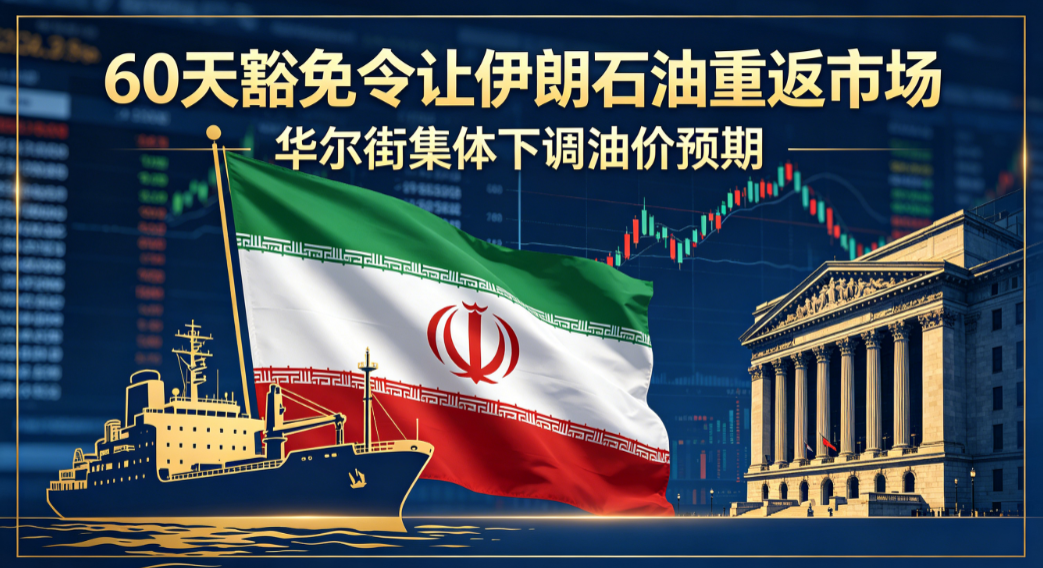
Iran Oil Exemption Opens 60-Day Window: Buffer or New Volatility for Crude Oil Market?
Keywords: Iran oil, US sanctions, crude oil price, global supply-demand, Brent crude, geopolitics
On June 22 local time, US Treasury Secretary Bessent announced that the US Treasury has issued a 60-day general license authorizing the production, delivery, and sale of Iranian oil. Upon the news, international oil prices came under pressure, with light crude oil futures for August delivery on the New York Mercantile Exchange and London Brent crude oil futures declining respectively. Market expectations for Iran's return to the global supply chain quickly heated up.
This short-term exemption order has ostensibly opened a buffer for the long-tension situation in the Middle East, but whether it means the beginning of a relaxation or just a highly fragile temporary truce remains to be seen. For the crude oil market, the most direct question is not "can Iran sell oil?" but "at what speed and to what extent can Iran resume exports?" and how this change will impact the already sensitive global supply-demand balance.
Core differences not resolved
According to the announcement from the US Treasury's Office of Foreign Assets Control, this exemption is broad in scope, covering not only Iranian crude oil, petrochemical products, and related transactions, but also some banking, insurance, and transportation services. This means that the sanctions chain has seen a temporary loosening, with some previously cut trade and financial channels beginning to recover.
Iran reacted positively. Foreign Minister Araqchi described it as an important step in "lifting the blockade" and "unfreezing assets," and the central bank governor also disclosed that relevant documents had been signed during negotiations, with funds to be used gradually according to conditions. However, these developments do not equate to a fundamental reconciliation. Iran sees the lifting of sanctions as a prerequisite for starting nuclear negotiations, while the US emphasizes "conditional lifting" and "reversible mechanisms," meaning verification of compliance as the basis for continued progress.
In other words, although both sides have shown goodwill at the operational level, they have not yet formed a stable consensus at the strategic level. US President Trump proposed that Iran accept "large-scale weapons inspections," while Iran's Foreign Ministry stressed that its cooperation with the International Atomic Energy Agency will still follow its own laws and security decision-making mechanisms. If this contradiction cannot be resolved, the 60-day window may only delay conflict rather than end it.
Speed of Iran's oil return determines market pricing direction
The market is most focused on the pace and scale of Iran's crude oil return. Many analysts expect Iran's crude oil production and exports to gradually recover in the coming weeks: in the short term, daily production may return to 1.6 million barrels, exports could rise to 1-1.3 million barrels per day, and in the medium term may increase further to 1.7-2 million barrels. This expectation has already begun to change the global crude oil pricing logic.
Institutions such as Goldman Sachs, Morgan Stanley, and Citigroup have successively lowered oil price forecasts, reflecting the market's reassessment of increased supply. For investors, the key is not just whether Iran "can sell" but also "where it can sell." Once sanctions are loosened, the range of buyers that Iranian crude can reach will expand, creating more pronounced price competition pressure on Asia, the Middle East, and even some European markets.
However, a full return of Iranian oil is not without obstacles. Issues such as tank farm absorption, tanker shortages, transportation insurance, port security, and maritime mine clearance may slow the recovery process. Even if the paper-based sanctions exemption is in place, the crude oil that actually enters the market may not quickly reach pre-war levels. In other words, supply increase is a trend, but the pace may not be smooth.
Low inventory reality amplifies market vulnerability
Notably, the expectation of increased Iranian supply comes against a backdrop of low global crude oil inventories. The latest data from the US Energy Information Administration shows that US strategic crude oil inventories have fallen to their lowest level since 1983, and Cushing inventories are also approaching market warning lines. Low inventories mean that once geopolitical or transportation disruptions occur, oil prices are more prone to amplified volatility.
This also explains why the market is both worried about Iranian crude increasing depressing prices and remains highly alert to the Middle East situation. Because the core contradiction is not simply "oversupply" or "undersupply," but a "fragile balance"—insufficient inventory buffers, lingering transportation risks, and frequent policy changes—any single change can alter the price trajectory.
The International Energy Agency's assessment further highlights long-term risks: if the conflict ultimately finds a lasting resolution, global supply could increase significantly in the coming years, while demand recovery may not keep pace. At that point, the market could even shift from shortage to surplus. In other words, in the short term, oil prices are supported by geopolitical risks, but in the medium to long term, they may face repricing pressure from supply recovery.
Conclusion: 60-day window more like a probe than an endgame
Overall, the US's temporary exemption for Iranian oil sends an important signal to the crude oil market: geopolitics is shifting from unilateral pressure to a probing game of negotiations while easing. For Iran, it is an opportunity to return to the market and gain leverage; for the US, it is a strategic arrangement to lower tensions with limited concessions.
But at a deeper level, this is not a final arrangement that can completely change the Middle East pattern. Core issues remain unresolved, the mechanism design is still fragile, and the market's response to supply recovery is still in the expectation stage. Over the next 60 days, whether Iranian oil can steadily return, whether oil prices continue to decline, and whether negotiations see reversals will jointly determine whether this "temporary truce" ultimately moves toward relaxation or returns to confrontation.