
Title: BOJ Rate Hike Window May Move Forward: Key Inflection Point from "Overly Accommodative" to Policy Normalization
Keywords: BOJ, rate hike expectations, monetary policy normalization, inflation, yen, yield curve, financial conditions
Introduction
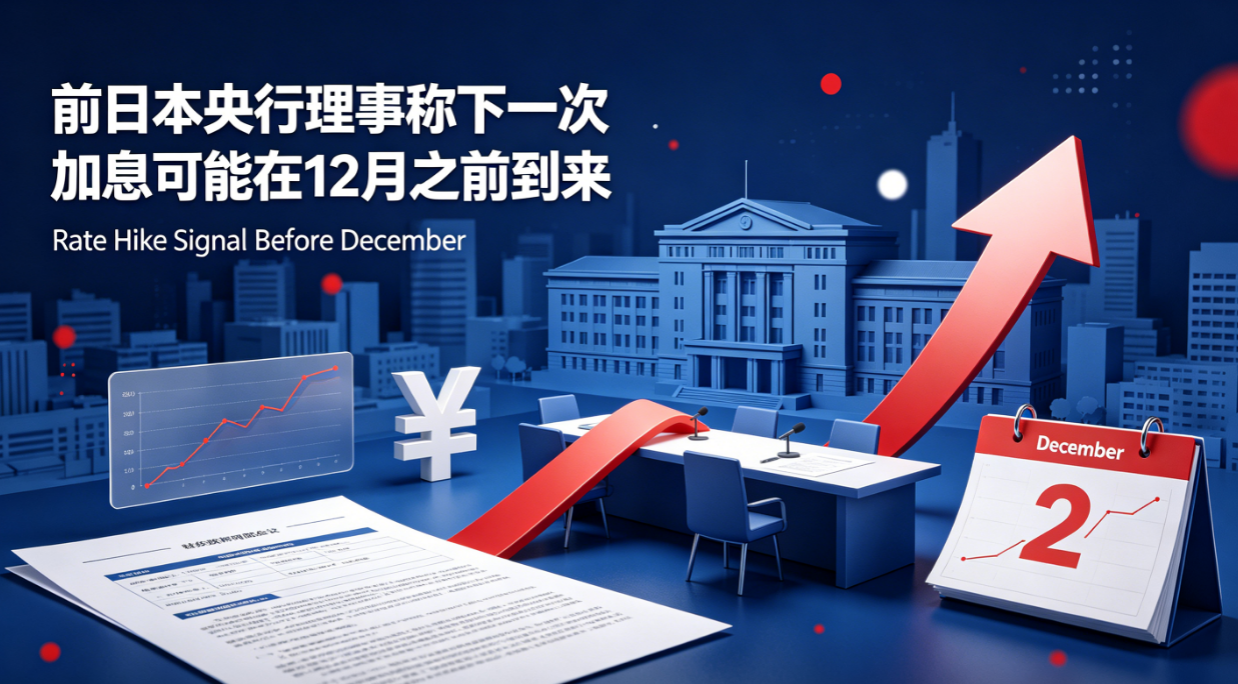
Former BOJ board member Kenzo Yamamoto recently stated that as the BOJ continues to push the still overly accommodative financial environment back to normal, its next rate hike may come earlier than the market generally expects. This statement is noteworthy not only because it comes from a former senior official deeply involved in policy-making, but also because it reflects that Japan's monetary policy is moving from "ultra-loose maintenance" to a new stage of "gradual tightening." For global markets, a rate hike by the BOJ is far more than a minor adjustment of domestic interest rates; it may mean the repricing of the yen, government bond yields, cross-border capital flows, and even the global liquidity structure.
1. Why an "earlier than expected" rate hike is becoming feasible
Yamamoto's core judgment is that the current financial environment of the BOJ is still loose, and there is a need to continue policy normalization. In other words, even though policy rates have been raised recently, real financial conditions remain loose: short-term rates are still low, real rates are still negative, corporate financing costs have not significantly risen, and the stimulative effect of the ultra-low rate environment on demand is still present.
From a technical perspective, the BOJ faces the dual constraints of "policy lag" and "inflation stickiness." In the past, the market generally believed that Japan would only continue to raise rates after sustained wage growth and stable achievement of inflation targets. But if the wage-price cycle has already shown some self-reinforcing characteristics, waiting too long may lead to insufficient monetary policy later, forcing the central bank to react passively in a steeper inflation path. Therefore, Yamamoto's emphasis on "the need to act quickly" is essentially a reminder to the market that the BOJ may want to complete a preventive adjustment before macro data gets completely out of control.
2. December is not the only window; policy pace may be more flexible
The market had generally bet on a BOJ rate hike in December, but Yamamoto's statement breaks this linear expectation. The underlying logic is that the central bank's decision no longer depends solely on a fixed meeting point, but on whether the data combination reaches the threshold for "continued normalization."
To judge whether the window is moving forward, three types of indicators should be observed: first, whether core inflation persists above the target range and has diffusion; second, whether nominal wage growth can cover inflation and steadily improve actual household income; third, whether financial markets have already priced in higher interest rates sufficiently to avoid excessive policy shock. If these three conditions improve simultaneously, the BOJ could well act before December. Even a rate hike that is more symbolic but meaningful for communication is enough to send a signal to the market that "policy normalization is still on track."
3. For the market, what is truly sensitive is the expectation gap
The market impact of each BOJ action comes not only from interest rates themselves but also from the "expectation gap." If investors have fully priced in a December rate hike, the real trigger for volatility is not the rate hike event itself, but a policy path that is "earlier, faster, and more sustained." For the yen, a policy move forward typically strengthens the logic of narrowing interest rate differentials and increases the attractiveness of the local currency; for Japanese government bonds, the long-short end yield curve may become steeper, especially as the medium-short end is more sensitive to policy rates; for global asset allocation, the repatriation of Japanese capital may also temporarily tighten overseas liquidity.
It is noteworthy that the BOJ is not currently in an aggressive tightening cycle, but rather slowly retreating from extreme accommodation to neutrality. This means the key to future policy is not the magnitude of a single rate hike, but whether the path is stable, communication clear, and the exit pace controllable. If the pace is mismatched, too rapid tightening may suppress recovery; but if procrastinated too long, it may de-anchor inflation expectations and increase future adjustment costs.
Conclusion
Overall, Yamamoto's view conveys an important signal: the BOJ's policy focus has shifted from "maintaining ultra-accommodation" to "accelerating normalization." With inflation and wage improvements still evolving and financial conditions not yet significantly tightened, the next rate hike indeed has the potential to be earlier than market expectations. For investors, what really needs attention is not "whether there will be a rate hike," but "at what pace the BOJ will complete normalization." Once this pace is recalibrated, the yen, bond markets, and global capital flows may all face a new round of reassessment.