South Korea Bets Its National Fortune on AI: A Mega-Bet on the Next 20-30 Years
Keywords: South Korea AI investment, semiconductors, HBM, AI data centers, physical AI, Samsung, SK Hynix
Introduction: Why is South Korea suddenly going all out?
South Korea's recent moves in AI can be summed up in one phrase: no more pretending, just going all in.
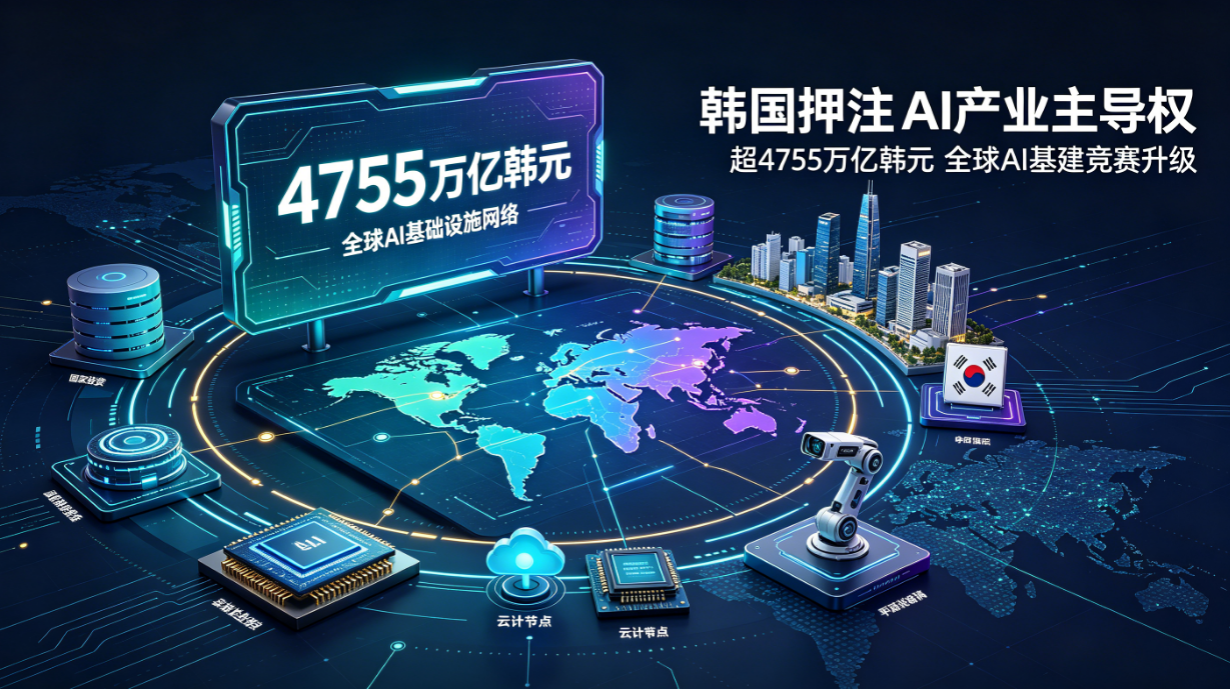
On June 29, the South Korean government, together with Samsung and SK Hynix, unveiled three "mega projects" in semiconductors, physical AI, and AI data centers. The two giants will jointly invest up to 4,755 trillion won in the future, a scale rarely seen in South Korea's history.
This is not simply corporate capacity expansion, but more like a national-level strategic bet. Because in South Korea's view, AI is not a hot concept but the foundation of the country's fortune for the next 20-30 years. Whoever lays a solid "AI foundation" in computing power, chips, electricity, and data centers first will be more likely to gain an edge in the next round of industrial competition.
1. Why is South Korea betting so heavily?
First, look at the big picture. Goldman Sachs expects global AI infrastructure costs to reach $4 to $8 trillion over the next five years; PwC even pushes the global key infrastructure investment demand before 2050 to over $150 trillion. In other words, AI is no longer just about "buying a few GPUs and building a model," but has evolved into a mega-project around electricity, chips, data centers, and supply chains.
South Korea's anxiety is also realistic. Its economic growth is slowing, and it faces old problems like population aging, labor reduction, and rising welfare pressure. Traditional manufacturing, no matter how strong, ultimately needs to find a new engine. AI happens to be the direction most likely to bring a second growth curve.
More importantly, South Korea has cards to play. Samsung and SK Hynix are already at the global forefront in the memory chip field, especially HBM, a "hard currency" of the AI era. The two companies together account for about 70-80% of the global market. The larger the AI models and the more data centers, the stronger the demand for high-bandwidth memory, and South Korea certainly does not want to miss this window.
2. This investment is not just "spending money," but "staking a position"
The most interesting thing about South Korea's latest layout is not how much it invests, but how strategic it is.
Samsung focuses on multiple regions including the Seoul metropolitan area, Honam, Chungcheong, and Yeongnam, expanding semiconductor capacity while also laying out related industries such as robotics, batteries, display panels, and AI server packaging, clearly building a more complete AI manufacturing chain. SK Hynix focuses on memory capacity expansion, especially DRAM and NAND, while also vigorously promoting AI data centers and supply chain expansion.
Behind this is a clear logic:
The AI era is not about single-point champions, but system capabilities.
Chips must be available, electricity must be sufficient, data centers must be fast, manufacturing must be able to take on scenarios, and robots must be able to land. South Korea's government-proposed "physical AI" is essentially to turn AI from algorithms on a screen into tools that actually work in factories, logistics, defense, education, and disaster response. This is a smart approach, because only by letting AI into industrial sites can data and demand be continuously fed back, forming a positive cycle.
3. South Korea's confidence comes from "the inflection point not yet reached"
Many may ask: Is the AI boom overheated? Is memory chip demand about to peak?
South Korea dares to bet heavily precisely because it believes it is "still early."
From market data, the proliferation of large AI models has only begun to transmit demand to the memory chip level. Rising DRAM and HBM prices indicate that demand is indeed very strong, but supply expansion is not that fast. Sigmaintell even expects that global DRAM demand will continue to grow in 2026, and supply growth will still lag behind.
This means that what South Korea sees now is not a bubble bursting, but a window where orders, capacity, and technology upgrades arrive simultaneously. Expanding capacity now may not be "chasing highs" but "staking a position."
Of course, risks are not absent. AI infrastructure construction is cash-burning, long-cycle, and returns may not be realized immediately. Moreover, global competition is already white-hot, with the US, Japan, and China accelerating their chase. Micron, Kioxia, and CXMT are all eyeing the memory market. If South Korea does not keep running, its advantages may not be sustained.
Conclusion: This is not an ordinary investment, but a national transformation
South Korea's choice this time is essentially answering the question: What will drive future national growth?
Its answer is clear: rely on AI, semiconductors, physical AI, data centers, and re-integrating manufacturing with intelligence.
This approach is aggressive, but also very suited to South Korea's reality: a small land area, a small market, and uncertain external environment. To maintain global competitiveness, it must concentrate fire on a few strategic tracks. Rather than spreading bets, it is better to put the strongest manufacturing capabilities and most mature memory advantages directly on the main line of AI.
In other words, South Korea is not betting on whether AI will become hot, but betting:
Whoever can turn AI into true infrastructure first will eat the dividends of the next industrial revolution.
This mega-bet has just begun, and the global AI infrastructure competition will only become more intense.